

In Part 1, I shared how I lived with fibroid symptoms for years without knowing what was actually going on in my body (link to Part 1 here). This post is about what surgery day looks like and what you need to pack in your hospital bag and all the information I wish I had beforehand. Fun fact, I also discovered that the hospital bag is exactly identical to when you are going to give birth, don’t quote me ke. I am finding that female related transitions are interlinked. Happy reading.
The Surgery
My gynae recommended an abdominal open myectomy. There are three types of myectomy surgeries (i) Hysteroscopic Myomectomy: its performed using a thin, lighted tube (called a hysteroscope) that goes through the vagina and cervix so there’s no incision on the belly. It’s usually done for fibroids that grow into the uterine cavity. (ii) Laparoscopic or Robotic Myomectomy: Involves small abdominal incisions. (iii) Abdominal (Open) Myomectomy: Recommended for large or numerous fibroids. Its performed through a larger incision in the belly, similar to a C-section. It’s usually done when fibroids are big, numerous, or hard to reach with minimally invasive methods. Recovery takes a bit longer than laparoscopic surgery. There is another option which is a guaranteed cure for fibroids known as a hysterectomy, which involves the complete removal of the uterus. It’s offered as an option if the fibroids are cancerous and you’re past childbearing age, or you don’t want future pregnancies.
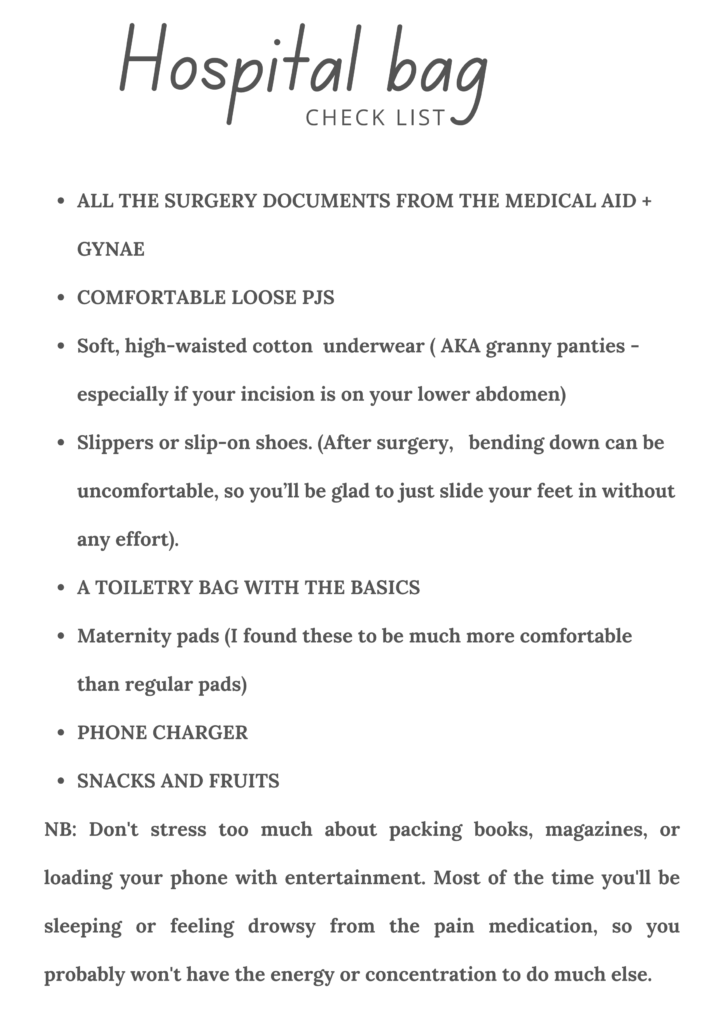
It was a Tuesday, on 24 May 2022, where surgery took place. My friend, who had previously had a C-section, helped me pack my hospital bag since I had no idea what I would need. This little gesture was also a tug at my heartstrings, a constant reminder that our hardest moments are made bearable by our community. Here’s a list of what I packed and what I actually found useful.
On the day
I had to be at the hospital by 5am, even though the surgery was at 9am.. After check-in, I changed into a hospital gown, had to sign a million forms (including consent for a blood transfusion, just in case I lost more blood than expected during the surgery), had a catheter inserted, drip in, and off to theatre I went.
The surgery took about three hours. Waking up was rough, I was in pain and the anaesthesia hadn’t fully worn off, so I was dozing in and out of sleep. This experience was wild for me. I don’t have words to explain what being put to sleep was like. Firstly, it didn’t feel like three hours. Post-op, I had a sore throat, since I had a tube down my throat. The doctor had explained just before I was “put to sleep”, that they would insert it to inflate my tummy so they could see the organs clearly during the op,so naturally, my throat would be sore afterwards. The star of the day was definitely the morphine drip. I could control it myself, and because I had the powers to do so, I was pumping it every two hours, cause wow. My doctor had explained beforehand that blood loss is quite common in this type of surgery, and if necessary, they would either give a transfusion or try to manage it carefully during the procedure. Fortunately, I did not need any blood transfusion, the procedure went well with no complications. I was so relieved that a blood transfusion wasn’t needed in my case.
For someone who loves food, I was only given food later that evening. Not that I was thinking of food at that moment. I was in so much pain that my priority was pumping the morphine and sleeping it off. My first meal was the classic hospital jelly-and-custard combo.
In hospital (4 days)
Day two started early, a nurse came to check vitals, clean and dress my wound and remove the catheter. The cool part about having passionate professionals during recovery is that the nurse shows you how you would need to take care of your operation wound once they discharge you to avoid infections etc. My first task that day was getting out of the hospital bed and taking my first walk. Bafazi it was very uncomfortable, painful actually, I couldn’t walk up straight. By day 2, the morphine is done and the pain management shifts from the drip to oral (TMI, there was one I got through the bum which worked really quick).
The recovery team is also made up of a dietitian and physio, who also came through. The dietitian discussed my nutrition and how to support my recovery, particularly given my iron and vitamin D deficiencies, while the physiotherapist showed me some gentle movements to help get my body moving safely again and reduce the risk of complications from being in bed for so long.
I also noticed light bleeding around this time, which my gynae told me to expect. I was given maternity pads (a brand by Dr. White), (I used these throughout, I found them to be the best for me as I spent most of my time laying down). During the time, I wasn’t sure if it was my period or post-surgery bleeding, but the nurses further reassured me that light bleeding can be normal after this type of procedure.
I stayed in hospital for four days in total and was discharged on the Saturday morning.
The recommended healing period is between 4 to 6 weeks, but it really depends on your body and the type of procedure you had.
Post- recovery
The first two weeks at home were the hardest for me. The pain felt stronger once I left the hospital, and the medication didn’t always feel as effective compared to when I was in hospital. The most important thing during this time is wound care. I cleaned my scar twice a day using warm water, salt, and surgical spirit as instructed. Bed rest and minimal movement are very important during the first two weeks. The doctor’s advice to take it easy is not an overstatement. The last thing you want is for your wound to open and require further stitching. Most of the medication also makes you drowsy, so you end up sleeping for most of the day anyway. By week three, the pain became more manageable. I was able to walk with no issues. Physically I was feeling better, however I knew that internal healing takes time and shouldn’t be rushed.
I rested for a total of six weeks, including the week spent in hospital, and was only ready to return to work on week seven.
Life after surgery
I expected life to go back to normal at the end of my six weeks healing period. However, there were so many things happening in my body that I didn’t understand. To be honest, I also wasn’t actively searching for answers at the time. Whenever I had a follow-up appointment, I would ask my gynaecologist the questions that came to mind. During this period, I also found out that my iron levels were extremely low and that I had a vitamin D deficiency. Although my gynaecologist prescribed medication, I didn’t take it as seriously as I should have. I just couldn’t understand why everything seemed to be happening to me all at once.
I gained a lot of weight during this time. I tried losing it the only way I knew how, but nothing seemed to work. I got a personal trainer, saw a dietitian, and even had someone prepare my meals, but I swear the weight said, “baby we are home, not going anywhere”. I was later diagnosed with Polyendocrine Metabolic Ovarian Syndrome (PMOS), which is the new name for PCOS. That’s when I learned that, for someone with PMOS, a calorie deficit alone is not enough. I eventually gave up on trying to lose weight and spent the next two years hating my body while not doing much about it. I would exercise and eat well for a while, fall off the wagon, and then start all over again. I kept losing and gaining the same 2kgs.
This year though, I finally gave myself the chance to heal. You know the saying, “Acceptance is the foundation for healing”? Or is it, “A problem identified is a problem half solved”? I mean for me, my problems had been identified for a while. I knew about the fibroids and the possibility of them coming back. I knew my iron levels were extremely low. I knew I had a vitamin D deficiency. I even knew I had PCOS. I knew I had to make changes to my lifestyle. I honestly had to accept my reality and only then could I stop fighting my body and start working with it instead of against it. I have even learned to understand my body’s language. We are still a work in progress, but id say we are 60% there. I will share more on understanding my body and my weight loss journey in my next blog post.
Looking back, I remember searching for exactly this kind of information before and after my surgery and coming up short. If this post has helped you feel a little more prepared for surgery day, the hospital stay, or what recovery actually looks like, then it’s done its job. That’s the reason I’m writing this series: to be the resource I couldn’t find.
Nice breakdown! Would love a deeper dive into office attire.