
Raise your hand if you’ve spent years starting over every Monday, only to gain and lose the same 2,5 kilograms. Sound familiar? You commit. You meal prep. You exercise. You lose a little weight, then life happens, and by December you’ve gained back everything you lost, and sometimes more. January arrives and you’re back to square one. This was me. I say “was”, because I think I’ve been doing pretty well this year, I started over one last time in February, and up until now, I haven’t needed to start again on another Monday. I have sort of figured out a system that works for me. I’m learning that our bodies communicate with us, and I’m slowly learning the language and that’s helping me with a lot of the issues I struggle with.
Where it started
The year 2020 changed a lot for most of us, and for me, weight loss was amongst the things I suddenly couldn’t manage. This was before I discovered I had fibroids and received a PMOS diagnosis. Our lives had changed. We worked from home and spent more time moving between the desk, couch and bed, all this whilst still having more takeaways, exercising less and having more wine. The weight kept going up and my normal “quick fixes” just weren’t cutting it anymore. I would commit to gym and eating healthy for a month or two, stop as soon as I see results and slowly slip back into my old habits, gain the weight back and repeat the cycle again. It was normal for me, and I didn’t see anything wrong with that. This went on until 2022 where I was diagnosed with PCOS (now officially renamed PMOS, known as polyendocrine metabolic ovarian syndrome, as of a global consensus published in May 2026) That was the same year I had fibroid surgery, and also the year I hit my biggest weight ever. My crash diets weren’t cutting it anymore. I also learnt that there’s medication to help with weight issues when diagnosed with PMOS, such as Metformin and GLP-1s. Both were recommended to me, by my gynae and my doctor. I tried Metformin for a month, and while I finally saw the scale move, the diarrhoea that came with it was so bad that I couldn’t continue. The diarrhoea lasted the entire month I was on it. I wasn’t ready for the GLP-1 route yet either because I didn’t fully understand the long-term side effects and I couldn’t really afford it, combined with a fair amount of fear from what was being said about it online.
Back then, I was also convinced that the weight gain and my general struggles that year, even though I was doing everything “correctly”, were down to the contraceptive I was on. My gynae believed otherwise. I still believe it contributed greatly, kodwa I just can’t prove it. In fact, it contributed to a lot of things in my life. I ended up joining a support group on Facebook, until one day I woke up and used my free will to put an end to it. With most things, you get to decide when you don’t want something to terrorise you anymore. The other reason I opted out of the birth control and metformin was that I was just tired of it all, and I felt like none of it was really fixing the root cause. There were so many issues I was uncovering, most confirmed medically by doctors and I felt like we were just treating symptoms and not addressing what was underneath them.
The Dietitian enters the chat
Now if you have medical aid or can afford it and your relationship with food is not the best, get help my sister. In fact, if there is any way to make your life better and you have the means to access it, do it. There is no honour in unnecessary suffering.
I consulted a dietitian and her core advice was simple: eat smaller meals more regularly, and don’t let yourself get too hungry before you eat. For me specifically, waiting too long tends to spike my appetite and blood sugar at the same time, and I end up overeating in a way that undoes all my efforts of a calorie deficit (when you consume less calories than your body burns). Pre-Covid, I knew exactly how to starve myself and snap back, I needed two weeks and I would be back to factory settings. Now, your intermittent fasting, OMAD (one meal a day) and 2MAD (two meals a day) don’t work for me. I’ve tried all of them. Even NOMAD (No meal a day). I overeat, I get a million cravings I can’t seem to quench, and I always end up back where I started or worse. I want to be clear that this is my experience, not a universal rule. Meal timing affects everyone differently, and there isn’t one eating pattern that works for everybody. What matters is learning your own system that works for your body, what doesn’t, and how your body actually reacts, rather than following whatever plan is trending. Realising this reframed what my dietitian visits actually were: not just meal plans, but us building a system together. I’m overweight, there’s a weight range that’s healthier for my body, and we had to find a way to get there sustainably as someone who genuinely loves her food.
Where I’m at now
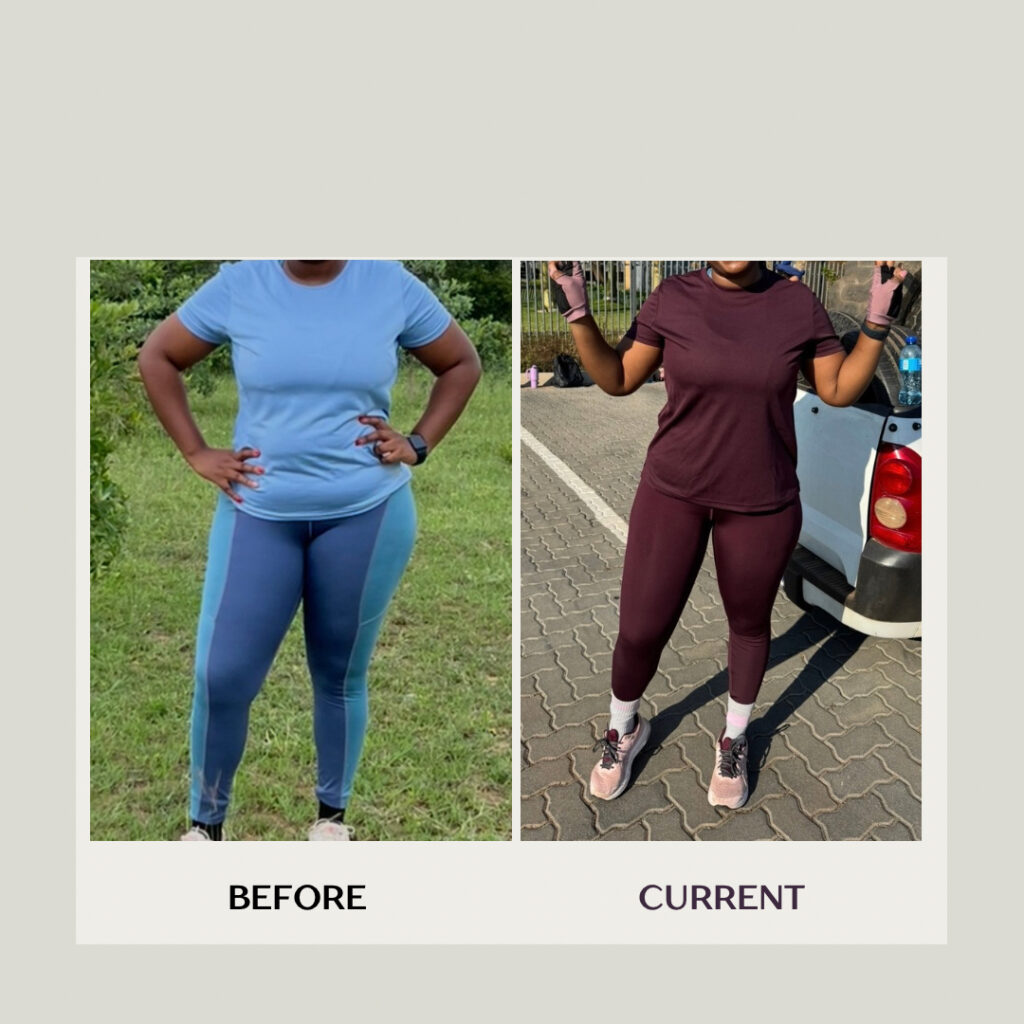
I am where the cool kids call “The messy middle”. The best part is that I don’t have to starve myself. I am finally losing weight, down two dress sizes. I look and feel good. Instead of constantly looking for another Monday to start over, I am building something that I can maintain even when life gets messy. I have learnt that a sustainable weight loss system isn’t about finding the perfect diet. A successful week can look like eating right 4/7 days a week. Finding a system I don’t constantly need to take a break from. Some weeks I lose 1kg, some 0 and some I gain. I have also learnt that the scale can’t tell muscle from fat or water. So sometimes what feels like fat, could actually be water retention.
This piece is not a declaration that I have it on lockdown, not at all. I am definitely still figuring out and piecing the puzzle together, understanding the “why” behind my dietitian’s advice, blood sugar, hormones, the insulin resistance sitting underneath the PMOS diagnosis . I am happy though that in all this, I don’t have to starve myself, I am eating all my meals, a gym bunny, a runner and a fitness influencer basically. Clock it!!
The System
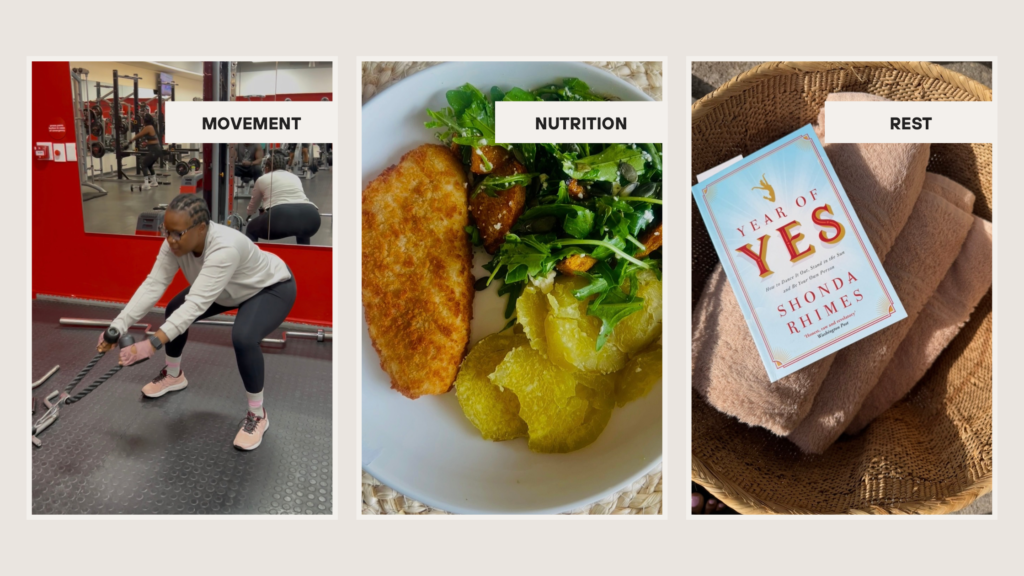
The system consists of three pillars which are food, movement and rest. The biggest one is food. It is true, you can’t out-train a bad diet. If you want to lose the weight, you are going to have to eat in a calorie deficit, meaning you consume fewer calories than your body uses. You can consult with a dietitian to help you figure this out or use apps like TDEE calculator, FatSecret and MyFitnessPal to estimate your calorie needs and track your intake. You also need to move your body consistently, you can walk, go to the gym, run or hike, whatever works for you. I prefer exercising in the morning because once I have worked out, I feel good and have more energy for the day. I also find that I make better food choices afterwards and have more control of my day in the morning than I do in the afternoons. Getting yourself to exercise might be the hardest part, but I promise you’ll feel so much better afterwards. The final pillar is rest. Getting enough sleep and giving your body time to recover is just as important. You cannot pour from an empty cup, and you cannot expect your body to perform at its best without giving it time to rest.
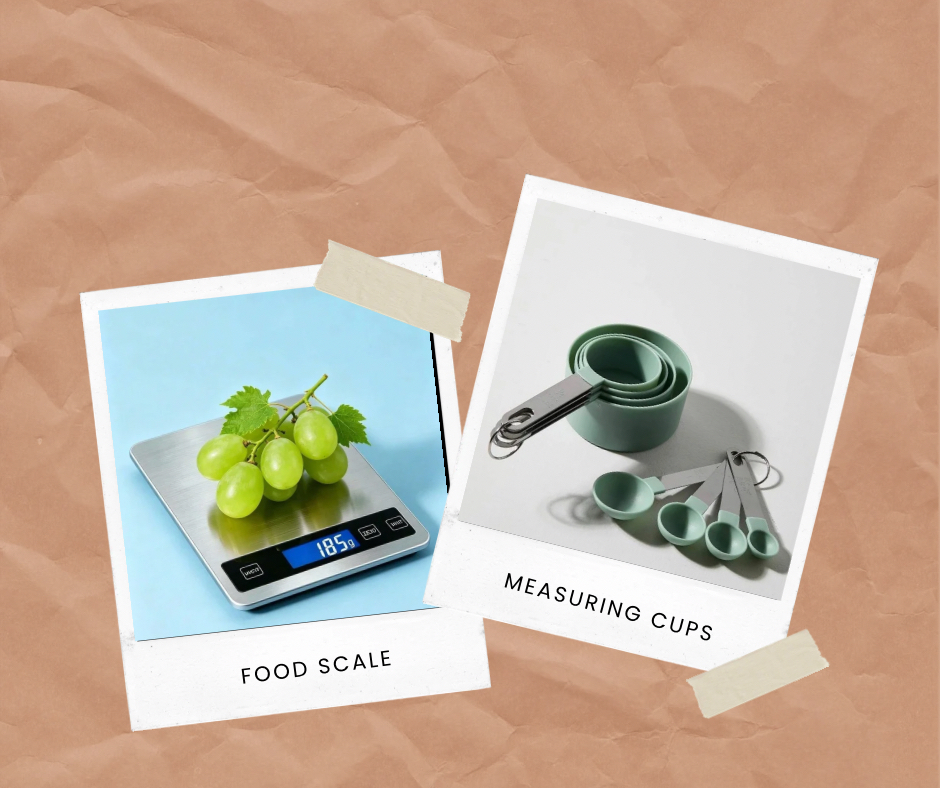
My meal plan is built around five meals a day, eaten roughly every two hours: breakfast, lunch, supper and two snacks, while aiming to drink minimum two litres of water daily. I measure my meals using a food scale and measuring cups. Each meal contain carbohydrates, vegetables and protein. The vegetables are divided into what we call free vegetables and starchy vegetables. The free vegetables are mostly the green vegetables, which I can eat as much as I want, such as cabbage, lettuce, spinach, broccoli and salads. The starchy vegetables include pumpkin, green beans, carrots and beetroot, with one portion being ½ a cup.
Fruit is also divided into green, orange and red groups. The green group includes berries, grapefruit, kiwi, lemon, nectarines and plums. The orange group include Banana, guava, pineapple and pawpaw and the red group includes grapes and watermelon. The red group fruits I limit rather than avoid completely.
My breakfast is kept simple and usually rotates between Weetbix & All-Bran and Oats & mabele porridge when I’m not being lazy. My starch options include brown rice, basmati rice potatoes, sweet potatoes, corn, wholewheat pasta and quinoa.
My protein options include chicken breast, mince, steak, fish, eggs and tuna. My fat options include avocado, nuts and olives.
So, what does a typical day actually look like for me?
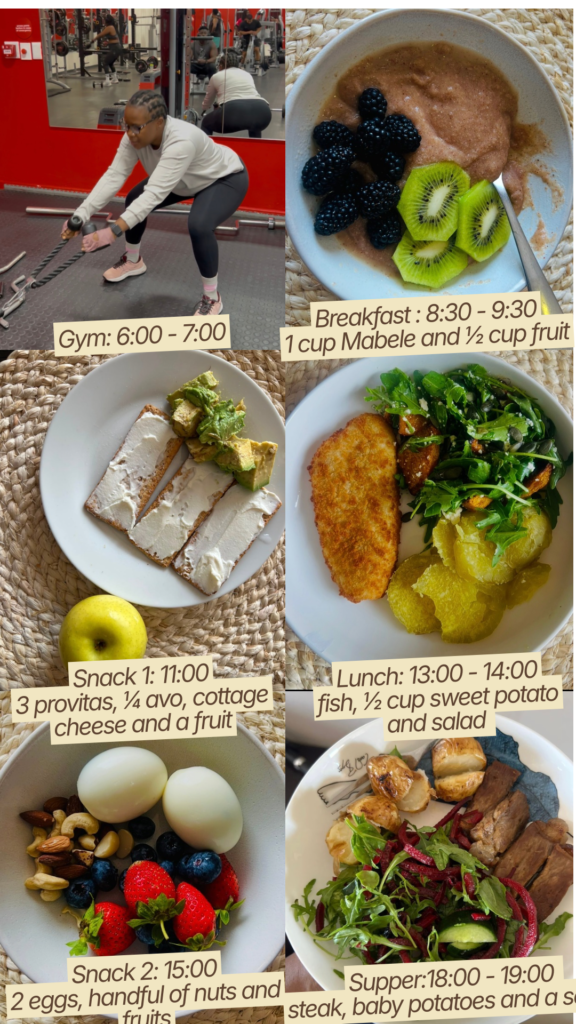
To simplify my life, dinner is usually also my lunch for the following day. My meal prep doesn’t involve bulk cooking because I prefer eating freshly cooked food and can comfortably eat food for up to two days. For me, meal prep is more about preparing my ingredients and planning my menu for the week. I choose three starches, four vegetables, three fruits and three proteins that I’ll be eating throughout the week. I also make sure I have all the ingredients I need for the week, most of which are fresh vegetables and fruits. As the saying goes “failing to plan means you are planning to fail”.
I work out five times a week. Monday to Thursday is a mixture of HIIT and strength training, Friday is rest day and on Saturday I usually run or walk 10km. I aim to get at least 8000 steps a day to keep myself moving outside of my workouts.
One last tip, besides consulting with a dietitian for a plan that’s personalised for you, do your blood tests. Sometimes vitamin deficiencies can be part of the reason why you’re struggling to lose weight, even when you’re doing everything “right”, and beyond weight, it just helps you understand what’s actually happening inside your body. On that note please don’t take supplements just because people on the internet are taking them. Your supplements and dosage should be informed by actual blood test results and advice from your doctor, not intuition and definitely not what worked for someone on the internet. Sometimes, you’ll come across someone online sharing symptoms that sound very similar to yours. While it can be tempting to follow their advice or try what worked for them, similarities in symptoms don’t necessarily mean you have the same diagnosis or that your body will respond in the same way. Following someone else’s journey can sometimes leave you frustrated when you don’t see the same results they did.
If you have been diagnosed with PMOS (PCOS), you already know the frustration. The process is not as straightforward as simply eating in a calorie deficit and exercising. A calorie deficit is important, but it is only one part of the process. The are other pieces of the puzzle. Some of us may find fat loss more difficult, particularly around the midsection, “mokhaba” and may also experience things like blood-sugar and insulin regulation issues, elevated androgens, irregular ovulation, inflammation, poor sleep or changes in appetite and cravings. The combination is different for everyone, which is why I think it is important to understand your own health markers in order to come up with an effective weight loss strategy. For me, over and above getting help from the dietitian, I had to do blood work with my doctor to understand better what was happening inside my body, including identifying any deficiencies so I could address them through the right foods and where necessary, the appropriate supplements. I also make sure that I get enough sleep ( 7 – 8 hours), pay attention to what I eat and when I eat, and try to take 5 – 10 minutes walks after my meals. None of these things replaces the fundamentals of nutrition and a calorie deficit required for fat loss. Rather, they are the additional pieces of the puzzle that have helped me look at weight loss as part of a bigger picture that includes metabolic, hormonal and overall health.
Very informative. 👏🏼👏🏼 Thank you for sharing.